AUTHOR: HUSSAIN ALI
WEBSITR: DAILYSCOPE.BLOG
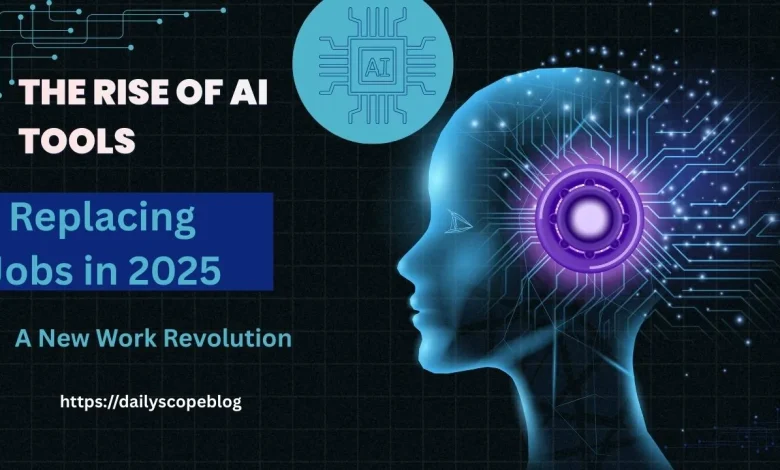
Rise of AI Tools Replacing Jobs
The impact of AI on the job market is both massive and nuanced. While headlines often focus on job displacement, the full picture involves significant job creation and a fundamental shift in the tasks that constitute work.
By the Numbers: Job Displacement and Creation
The Rise of AI Tools Replacing Jobs
Recent analyses from the world’s leading economic institutions quantify the scale of the change underway.
- Widespread Displacement: The World Economic Forum’s Future of Jobs Report 2025 estimates that 92 million roles could be displaced by 2030. In the more immediate term, another report suggests 85 million jobs could be displaced by 2025. Investment bank Goldman Sachs has projected that AI could replace the equivalent of 300 million full-time jobs globally, a figure that represents about 9.1% of the worldwide workforce.
- Significant Creation: This displacement is only one side of the coin. The same World Economic Forum report forecasts the creation of 170 million new jobs by 2030, leading to a net gain of 78 million jobs. This indicates that the AI revolution, in aggregate, is likely to be a net creator of employment, though the new jobs will require different skills.
- Task Automation: Beyond whole jobs, the automation of tasks is pervasive. Research cited by ARXIV indicates that 80% of the US workforce could have at least 10% of their work tasks impacted by large language models. Goldman Sachs estimates that roughly 25% of all work tasks could be done by AI, with this figure soaring to 46% for administrative roles and 44% for legal jobs.
The Core Driver: The Data Paradox
A key to understanding which jobs are being transformed first lies in what can be termed the “Data Paradox.” The rate of AI adoption in a given field is less about the complexity of the tasks and more about the availability of high-quality, accessible data for AI systems to learn from.
AI models, particularly large language models (LLMs), are trained on vast datasets. Industries that are data-rich, such as software development (with its billions of lines of public code) and customer service (with its extensive archives of calls and tickets), are seeing rapid AI integration. In contrast, data-poor industries like construction (with its poor digital record-keeping) and healthcare (with data fragmented and locked away by privacy laws) are experiencing slower, more friction-filled adoption. This is why, paradoxically, AI is currently replacing some complex cognitive tasks faster than simpler manual ones.
The Front Lines: Jobs AI is Replacing and Transforming in 2025
The AI revolution is not impacting all professions equally. The roles most vulnerable in this initial phase are those characterized by repetitive, data-centric tasks. The following table breaks down the most affected sectors and the specific roles within them that are undergoing rapid change.
The Evolution of High-Skill Roles
It is a common misconception that AI only threatens low-skill jobs. In reality, many high-skill, white-collar professions are facing significant transformation.
- Software Development: With tools like GitHub Copilot trained on millions of public code repositories, AI can now generate, review, and debug code autonomously. This is augmenting developers but also automating many routine programming tasks.
- Research & Analysis: The ability of AI to sort, extrapolate, and analyze massive datasets is reducing the need for human intervention in the initial stages of data analysis and research.
- Creative Industries: AI tools like DALL-E and GPT-derived platforms are producing visual art, copywriting, and basic journalism at scale, disrupting fields like graphic design, advertising, and content creation.
A report from Pew Research Center highlights this trend, noting that 27% of workers with a bachelor’s degree or higher are employed in jobs considered “most exposed” to AI, compared to just 3% of workers with less than a high school diploma. Furthermore, these highly exposed jobs tend to be better-paid, earning an average of $13.3 more per hour than jobs with low AI exposure.
The Other Side of the Coin: Job Creation and Augmentation
For every job displaced, new ones are emerging, and existing roles are being enhanced. The narrative of AI is not solely one of replacement but also of creation and collaboration.
The Emergence of New Roles
A new ecosystem of jobs is forming around the development, management, and ethical governance of AI. These include:
- AI/Machine Learning Engineers: The architects who design, build, and optimize the AI models themselves. This remains one of the most in-demand and highly compensated roles in the tech industry.
- AI Trainers, Prompt Engineers, and Data Annotators: These roles are critical to refining AI systems. They teach models by providing examples, design effective prompts to guide AI outputs, and label the data that trains AI algorithms.
- AI Maintenance and Monitoring Specialists: As companies deploy AI systems, they need specialists to manage day-to-day AI operations, ensure models run efficiently, and perform predictive maintenance.
- AI Ethics and Governance Officers: With growing concerns about bias, privacy, and safety, these professionals develop frameworks for the responsible and fair use of AI within organizations.
The Augmentation of Human Labor
In many cases, AI is not replacing workers but making them more productive and valuable. PwC’s 2025 Global AI Jobs Barometer found that AI is acting as a powerful force for augmentation, particularly in roles with high automation potential.
- Enhanced Productivity: Industries highly exposed to AI have shown three times higher growth in revenue per employee. AI tools handle the mundane aspects of a job, freeing up human workers for more strategic, creative, and interpersonal tasks.
- Wage Growth: Contrary to fears of devaluation, wages are rising twice as fast in the most AI-exposed industries. Furthermore, workers who possess AI skills command a significant wage premium of 56% compared to their peers in the same roles without those skills.
- The Human-AI Collaboration: The future of work in most fields will be a symbiotic partnership. A radiologist uses AI to pre-screen scans, focusing their expertise on complex cases. A marketer uses AI to analyze campaign data and generate content ideas, then applies human creativity to finalize the strategy. A lawyer uses AI for discovery, saving hundreds of hours and allowing more time for courtroom strategy and client counsel.
The Skills Earthquake: Preparing for the AI-Powered Workforce
The rapid pace of change is creating a “skills earthquake.” PwC reports that the skills required for jobs exposed to AI are changing 66% faster than for other jobs. Adapting to this new reality is the single most important task for both individuals and organizations.
The Most Valuable Skills in 2025 and Beyond
The World Economic Forum’s research identifies the core skills that will be most sought after by employers in the coming years:
- Technology-Related Skills: AI and Big Data tops the list as the fastest-growing skill, followed by Networks and Cybersecurity and Technological Literacy. These are no longer niche IT skills but foundational competencies.
- Cognitive and Critical Thinking Skills: Analytical thinking is considered the most essential core skill by 70% of companies. This is complemented by creative thinking, which allows humans to excel where AI falls short—in innovation, problem-framing, and originality.
- Social-Emotional and Leadership Skills: As automation handles technical tasks, intrinsically human skills become more critical. Resilience, flexibility, and agility are paramount for navigating constant change. Leadership and social influence, curiosity and lifelong learning, and empathy are what will differentiate human workers in the AI era.
Strategies for Individuals and Organizations
- For Individuals: The era of learning ending at graduation is over. Success requires a mindset of continuous learning and upskilling. Workers should proactively seek training in AI literacy and data analysis, focus on developing their cognitive and social-emotional skills, and be willing to adapt their career paths. As the WEF notes, if the world’s workforce was 100 people, 59 would need training by 2030 to keep pace.
- For Organizations: Companies have a responsibility and a strong business incentive to invest in their workforce. This includes:
- Upskilling and Reskilling: Implementing large-scale training programs to prepare employees for new roles and responsibilities. 85% of employers surveyed by the WEF plan to prioritize upskilling their workforce.
- Workflow Redesign: McKinsey’s research on “AI high performers” shows that a key to success is not just implementing AI, but fundamentally redesigning workflows around human-AI collaboration.
- Leadership Commitment: Successful AI transformation is championed from the top, with senior leaders demonstrating ownership and commitment to AI initiatives.
Navigating the Transition: Policy and Ethical Considerations
The AI-driven transformation of the labor market presents complex challenges that extend beyond corporate training rooms. It demands a coordinated response from policymakers, educators, and society at large to ensure the transition is just and equitable.
The most significant risk is the potential for a worsening of societal inequalities. The Yale Budget Lab’s analysis suggests that, so far, the labor market has not experienced a “discernible disruption” in the 33 months since ChatGPT’s release, indicating that widespread effects may take years to materialize. However, if left unchecked, the benefits of AI could accrue primarily to business owners and highly skilled workers, while mid-level, routine cognitive workers are displaced without a clear path forward.
To mitigate this, several policy actions are crucial:
- Strengthening Social Safety Nets: Modernizing unemployment benefits and exploring models like portable benefits that are tied to individuals rather than single employers can provide stability in a more fluid job market.
- Investing in Education and Retraining: Publicly funded reskilling programs, particularly targeted at workers in highly exposed industries, are essential. This also means rethinking public education to emphasize the durable skills of critical thinking, creativity, and collaboration from an early age.
- Fostering a Culture of Lifelong Learning: Governments and companies can incentivize continuous education through learning accounts, tax credits, and paid learning sabbaticals.
- Developing Ethical AI Frameworks: Robust regulations are needed to address issues of algorithmic bias, data privacy, and transparency, ensuring that AI is used to augment human dignity rather than undermine it.
Conclusion: Embracing a Fearless Future
The rise of AI in the workplace is not an apocalypse nor a utopia; it is a complex, ongoing revolution. The year 2025 is a clear inflection point, where the technology has moved from pilot projects to core business operations, bringing both disruption and opportunity.
The path forward requires a clear-eyed understanding of the changes at hand. Jobs involving repetitive tasks, whether manual or cognitive, will continue to be automated. However, this automation is also unlocking new levels of productivity, fostering innovation, and creating entirely new categories of work that we are only beginning to imagine. The most successful individuals will be those who embrace lifelong learning, cultivating the technological, cognitive, and social-emotional skills that complement AI. The most successful organizations will be those that view AI not merely as a tool for cost reduction but as a partner in achieving growth and innovation, investing heavily in their human capital to navigate the transition.
The Rise of AI Tools Replacing Jobs is becoming the biggest global shift of 2025, and as the Rise of AI Tools Replacing Jobs continues, industries everywhere are preparing for massive change. Experts warn that the Rise of AI Tools Replacing Jobs will impact both skilled and unskilled roles, and companies adopting automation say the Rise of AI Tools Replacing Jobs is reducing costs while boosting productivity. Workers are now studying the Rise of AI Tools Replacing Jobs to understand how their careers might transform. From offices to factories, the Rise of AI Tools Replacing Jobs is shaping new opportunities, while many fear the Rise of AI Tools Replacing Jobs could disrupt traditional employment. Governments worldwide are discussing the Rise of AI Tools Replacing Jobs as they plan future policies. Students are also noticing the Rise of AI Tools Replacing Jobs, influencing education and new skill demands. As technology grows, the Rise of AI Tools Replacing Jobs accelerates daily. Businesses believe the Rise of AI Tools Replacing Jobs is unavoidable, and experts say embracing the Rise of AI Tools Replacing Jobs is the only way to survive. With every major update, the Rise of AI Tools Replacing Jobs gets stronger, proving that the Rise of AI Tools Replacing Jobs is not just a trend but a permanent transformation. Ultimately, the Rise of AI Tools Replacing Jobs marks the beginning of a new future, and understanding the Rise of AI Tools Replacing Jobs today will define who succeeds tomorrow.