Agentic AI Explained: How Autonomous AI Agents Are Changing the World

AUTHOR: HUSSAIN ALI
WEBSITE: DAILYSCOPE.BLOG
Introduction: The Dawn of Autonomous AI
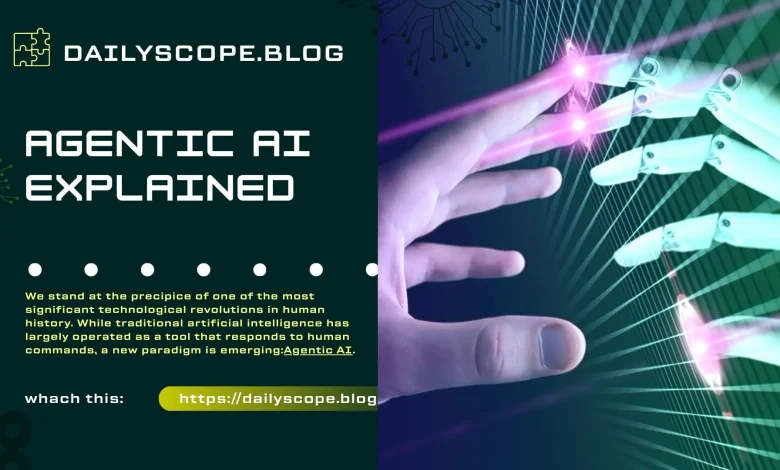
We stand at the precipice of one of the most significant technological revolutions in human history. While traditional artificial intelligence has largely operated as a tool that responds to human commands, a new paradigm is emerging: Agentic AI. These systems can act independently to achieve complex goals with minimal human supervision. Imagine an AI that doesn’t just generate content when prompted, but can plan and execute an entire business process, from analyzing data to taking actions across multiple software systems. This is the promise of autonomous AI agent systems that don’t merely suggest but actually perform, transforming how work gets done across every sector of our economy.
The shift from generative AI to agentic AI represents a fundamental change in how we interact with artificial intelligence. While generative AI models like ChatGPT focus primarily on creating content based on learned patterns, agentic AI extends this capability by applying generative outputs toward specific goals through autonomous action. These systems can search the web, call application programming interfaces (APIs), query databases, and then use this information to make decisions and take actions. The term “agentic” refers to these models’ agency—their capacity to act independently and purposefully.
The excitement around this technology is palpable. According to industry surveys cited by IBM, 99% of developers building AI applications for enterprise are currently exploring or developing AI agents. Major tech companies, including Google, Amazon, NVIDIA, and IBM, are investing heavily in agentic AI platforms, while businesses across sectors are piloting these systems to automate complex workflows that previously required human intelligence and intervention. As NVIDIA’s blog states, “Agentic AI uses sophisticated reasoning and iterative planning to autonomously solve complex, multi-step problems.
This in-depth exploration will examine how agentic AI works, its real-world applications across industries, the economic impact it’s already generating, and what businesses and society need to consider as we approach this technological frontier. We’ll move beyond the hype to present a clear-eyed view of what’s possible today versus what remains on the horizon, providing readers with a comprehensive understanding of one of the most significant technological developments of our time.
What is Agentic AI? Beyond Conventional Automation
At its core, Agentic AI refers to artificial intelligence systems that can accomplish specific goals with limited supervision, consisting of AI agents and machine learning models that mimic human decision-making to solve problems in real
time. Unlike traditional AI models that operate within predefined constraints and require human intervention, agentic AI exhibits autonomy, goal-driven behavior, and adaptability.
To understand what makes agentic AI special, consider how it differs from conventional AI and automation:
Table: Comparison of Traditional AI vs. Agentic AI
| Feature | Traditional AI/Automation | Agentic AI |
|---|---|---|
| Autonomy | Follows predefined rules and workflows | Acts independently with minimal supervision |
| Goal Orientation | Executes specific commands | Pursues higher-level goals with strategic planning |
| Adaptability | Limited to predefined scenarios | Learns from experience and adjusts strategies |
| Tool Usage | Limited integration capabilities | Can utilize APIs, databases, and software tools |
| Complexity Handling | Best for repetitive, structured tasks | Capable of managing complex, multi-step problems |
The key distinction lies in agency the capacity for independent action. As IBM explains, “Unlike traditional AI models, which operate within predefined constraints and require human intervention, agentic AI exhibits autonomy, goal-driven behavior, and adaptability. Where traditional software follows predetermined rules and basic AI requires prompting and step-by-step guidance, agentic AI is proactive and can perform complex tasks without constant human oversight.
Another crucial differentiator is how agentic AI systems handle tool usage. While conventional AI might analyze data or generate content, agentic AI can take actions in the real world, whether digital or physical. “LLMs by themselves can’t directly interact with external tools or databases or set up systems to monitor and collect data in real time, but agents can,” notes IBM’s research. “Agents can search the web, call application programming interfaces (APIs) and query databases, then use this information to make decisions and take actions.”
This represents a fundamental shift from tools to teammates. As AWS Insights describes, “Autonomous AI agents represent the next significant evolution in artificial intelligence, moving beyond conversational interfaces to systems that leverage AI to reason, plan, and complete tasks in tandem with or on behalf of humans.
Distinguishing Agentic AI from Generative AI
While agentic AI and generative AI are related technologies, they serve different functions. Generative AI focuses primarily on creating content text, images, code, or music, based on input prompts. The large language model (LLM) is at the heart of generative AI, and value is generated by what the model can create through simple extensions of the LLM’s capabilities.
Agentic AI, in contrast, goes beyond content creation. As Google Cloud explains, “Agentic AI is a subset of generative AI that is centered around the orchestration and execution of agents that use LLMs as a ‘brain’ to perform actions through tools. Where generative AI might create marketing materials, agentic AI would deploy those materials, track their performance, and automatically adjust the marketing strategy based on the results.
UiPath elaborates on this distinction: “GenAI is built to create copy, images, code, and ideas. Its ability to support natural language processing makes it a powerful tool for content generation. Agentic AI, by contrast, is built to act. It plans, decides, and executes to reach outcomes. Where GenAI stops at creation, agentic AI continues implementing actions, triggering workflows, and adapting to new circumstances.
How Agentic AI Works: The Architecture of Autonomy
Agentic AI systems operate through a structured framework that enables them to perceive, reason, act, and learn. While implementations vary across different platforms and use cases, most follow a similar operational pattern that mirrors human problem-solving approaches.
The Core Operational Framework
- Perception: Agentic AI begins by collecting data from its environment through sensors, APIs, databases, or user interactions. This step ensures the system has up-to-date information to analyze and act upon. The perception module serves as the agent’s “senses,” gathering raw information and transforming it into a structured format that the AI can understand. This can include text perception (using Natural Language Processing), visual perception (using computer vision), auditory perception (speech recognition), or multimodal capabilities that combine different data types.
- Reasoning: Once data is collected, the AI processes it to extract meaningful insights. Using the power of large language models (LLMs) with natural language processing, computer vision, or other AI capabilities, it interprets user queries, detects patterns, and understands the broader context. The LLM acts as the agent’s “brain,” performing high-level thinking: understanding requests, solving problems, breaking down goals, and creating plans. During this phase, the AI sets objectives based on predefined goals or user inputs and develops a strategy to achieve these goals, often using decision trees, reinforcement learning, or other planning algorithms .
- Planning: The AI then formulates a strategy to achieve its goals. As AWS describes, “Given a goal, the agent can plan, execute, and adjust a sequence of actions using a domain-specific toolkit, with minimal human oversight” . Modern agents employ sophisticated thinking strategies to guide the LLM’s reasoning process, including:
- Chain-of-Thought (CoT) Prompting: Encouraging the LLM to “think step by step” before giving a final answer .
- Tree-of-Thoughts (ToT) Prompting: Exploring multiple reasoning paths simultaneously and evaluating which ones to pursue further .
- ReAct (Reason+Act) Framework: Combining thinking with doing in a continuous loop of Thought → Act → Observe .
- Action: After selecting an action, the AI executes it, either by interacting with external systems (APIs, databases, robots) or providing responses to users . This is where the agent moves beyond thinking to doing—executing code, updating databases, triggering workflows, or controlling physical systems. As NVIDIA notes, “By integrating with external tools and software via application programming interfaces, agentic AI can quickly execute tasks based on the plans it has formulated” . Guardrails are often built into these systems to ensure they execute tasks correctly, such as requiring human approval for actions above certain thresholds .
- Learning and Adaptation: After executing an action, the AI evaluates the outcome, gathering feedback to improve future decisions . Through reinforcement learning or self-supervised learning, the AI refines its strategies over time, making it more effective in handling similar tasks in the future . NVIDIA refers to this as a “data flywheel,” where the data generated from interactions feeds back into the system to enhance models .
Multi-Agent Systems and Orchestration
For complex tasks, multiple AI agents often work together in coordinated systems. As IBM explains, “In a multiagent system, each agent performs a specific subtask required to reach the goal and their efforts are coordinated through AI orchestration” . There are different architectural approaches to multi-agent systems:
- Vertical Multi-Agent Systems: Feature a hierarchical structure where lower-level AI agents handle simpler tasks, while higher-level agents perform complex reasoning and decision-making . This architecture is ideal for sequential workflows but can be vulnerable to bottlenecks .
- Horizontal Multi-Agent Systems: Utilize agents working as equals in a decentralized fashion, with each agent specializing in a narrow skill . This approach is more flexible for solving complex scenarios but can be slower than vertical hierarchy .
- Orchestration Platforms: Coordinate and manage multiple agents and systems, automating AI workflows, tracking progress toward task completion, managing resource usage, monitoring data flow and memory, and handling failure events . With the right architecture, dozens, hundreds, or even thousands of agents could theoretically work together in harmonious productivity .
Real-World Applications: Agentic AI in Action
Agentic AI is already moving beyond theoretical potential to practical implementation across diverse sectors. Here are some of the most impactful real-world applications demonstrating how autonomous AI agents are transforming industries in 2025.
Healthcare: Enhancing Diagnostics and Patient Care
In healthcare, agentic AI is creating significant impact while maintaining appropriate safety safeguards. Companies are developing large language models specifically for healthcare that are expressly non-diagnostic in nature . Their task-specific agents handle high-volume, low-risk workflows, such as patient intake, chronic care management, post-discharge follow-ups, and medication adherence reminders . This approach scales preventive health at a lower cost while focusing relentlessly on safety through “constellation architectures” of supervising LLMs and testing by thousands of licensed clinicians .
In diagnostic applications, AI agents act as 24/7 digital assistants for pathologists . They autonomously analyze tissue samples, having learned from thousands of biopsies to identify microscopic patterns indicative of cancer. These agents assist human pathologists in identifying malignant cells with 99.5% accuracy, enabling earlier, more effective treatment . Beyond diagnostics, agentic AI is accelerating drug discovery by rapidly analyzing massive datasets, identifying potential drug targets, and predicting efficacy—dramatically compressing development cycles .
Finance and Banking: Autonomous Operations
The financial sector has emerged as a prime beneficiary of agentic AI technologies. In algorithmic trading, AI agents leverage specialized Financial Learning Models (FLMs) to autonomously process market data, predict trends, and execute trades with high precision . These agents function on 5- and 15-minute time frames, a significant leap from older hourly models . The results have been dramatic—one of the most tangible examples of agentic ROI, with leading agents in this space achieving significant annualized returns (in some cases exceeding 200%), with documented win rates of 65-75% .
Major enterprise software providers are embedding native AI agents directly into their cloud ERP platforms to power “touchless operations” and “real-time predictive insights” . The key strategic benefit is shifting the finance department’s role from reactive oversight to proactive foresight, enabling “measurable business impact” . Agentic AI is also transforming how financial institutions manage risk, with AI agents analyzing vast amounts of data to surface potential risks and vulnerabilities, helping institutions proactively manage exposure and ensure regulatory compliance .
Software Development: The Autonomous Engineer
Perhaps one of the most advanced applications of agentic AI is in software development. By 2025, autonomous coding AI agents have moved beyond simple code completion to full task automation . Leading platforms can take a natural language goal, generate code, write and run tests, analyze the results, and autonomously debug and refactor the code to achieve the goal .
This “fundamentally changes how software is built” by shifting the human developer’s role from a doer to a reviewer and strategist . Amazon, for instance, accelerated developer productivity for legacy application modernization by deploying agents using Amazon Q Developer . In 2024, Amazon integrated Java transformation capability into Amazon’s internal systems and migrated tens of thousands of production applications from older versions of Java 8 or 11 to Java 17, allowing developers to complete these upgrades in a fraction of the time, resulting in both performance improvements and cost savings across Amazon .
Supply Chain Management: Proactive Orchestration
In supply chain management, AI agents have transitioned from simple automation to autonomous orchestration . They connect to ERPs and external data sources (such as weather or commodity prices) to perform prescriptive recommendations, autonomous root cause analysis (tracing the reasons why a forecast failed), and “what-if” scenario modeling .
The benefit is the transformation of supply chain leaders from “reactive analysis to proactive decision making” . The ultimate goal is creating “self-healing supply chains” that are more resilient and antifragile . Agentic AI systems can proactively monitor inventory levels, track weather conditions, and anticipate shipping delays . They can raise alerts and even reroute shipments to reduce downtime, optimizing routes, predicting potential bottlenecks, and adjusting inventory levels based on demand fluctuations .
Customer Service: Intelligent Support Agents
Customer service has been transformed by agentic AI, with systems now handling complex queries, anticipating customer needs, and resolving issues with context-awareness . Unlike earlier chatbots that followed scripted pathways, modern AI agents can process customer service inquiries and rapidly search through available company documents to find suitable answers . If this alone isn’t enough to solve a query, agentic AI can communicate with the user to gather more information about their case and direct them toward a solution .
These systems are designed with modular components, such as reasoning engines, memory, cognitive skills, and tools that enable them to remedy the vast majority of problems . After several unsuccessful attempts, they can contact a human support agent and assign them to the case . This approach alleviates the burden on human teams and enables customer-oriented services to operate 24/7 . The result is hyper-personalized service that builds brand loyalty by providing customers with a top-notch experience when and where they need it .
Research and Development: Accelerating Innovation
In research-intensive fields, agentic AI is dramatically accelerating the pace of discovery. In the biotechnology sector, Genentech built an agentic solution on AWS that automates time-consuming manual search processes, enabling scientists to focus on high-impact research and accelerate drug discovery innovation . The system uses autonomous agents that break down complicated research tasks into dynamic, multi-step workflows .
Unlike traditional automation systems that follow predetermined paths, these agents adapt their approach based on information gathered at each step, access and analyze multiple knowledge bases using RAG, and execute complex queries by interfacing with internal APIs and databases . This agentic solution helps Genentech automate much of the manual effort required for biomarker validation across therapeutic areas, reducing time-to-target identification and accelerating innovation .
The Economic Impact: Projections and Business Transformation
The adoption of agentic AI is not just a technological shift—it’s producing substantial economic impacts that are already transforming business operations and showing even greater potential for the future.
Market Projections and Growth
Based on McKinsey estimates, generative AI is projected to contribute between $2.6 and $4.4 trillion annually to global GDP, with agentic AI playing a significant role in realizing this value . Gartner projects that at least 15% of work decisions will be made autonomously by agentic AI by 2028, as compared to 0% in 2024 . The AI agents market itself is expected to grow to $52.6 billion by 2030, reflecting a compound annual growth rate of approximately 45% .
In specific sectors, the projections are even more striking. In the US B2C retail market alone, agentic commerce could represent an opportunity to orchestrate revenue in the range of $900 billion to $1 trillion by 2030 . Globally, this opportunity is projected to range from $3 trillion to $5 trillion . These figures only reflect goods and do not yet include services or the significant B2B marketplace .
Productivity and Efficiency Gains
Organizations implementing agentic AI solutions are reporting substantial productivity improvements and cost savings:
- Software Development: Amazon’s deployment of AI agents for Java application upgrades allowed developers to complete migrations in a fraction of the time, resulting in both performance improvements and cost savings across the organization .
- Customer Service: Over half of service professionals report significant improvements in customer interactions, reducing response times and boosting satisfaction through AI agent implementation .
- Content Creation: Agentic AI can save marketers an average of three hours per content piece, allowing them to focus on strategy and innovation .
- Insurance Processing: One insurance implementation achieved an 80% reduction in processing time, cutting claims from days to hours through a multi-agent system that collaboratively processes each claim .
Implementation Challenges and the “Pilot Purgatory” Problem
Despite the promising potential, many organizations face significant challenges in implementing agentic AI at scale. According to McKinsey, while nearly eight in ten companies report using generative AI, just as many report no significant bottom-line impact . This is because 90% of function-specific, high-value use cases remain stuck in pilot mode .
A January 2025 Gartner poll shows that 42% of organizations have made only “conservative investments” in agentic AI, with 31% still in a ‘wait and see’ mode . The reasons for this hesitation center on trust, security, and governance. A 2025 Gartner survey found that only 15% of IT application leaders are considering, piloting, or deploying fully autonomous AI agents . A staggering 74% of respondents believe these agents represent a new attack vector, and only 13% strongly agree they have the right governance structures to manage them .
This trust gap leads to a stark prediction from Forrester: three out of four firms (75%) that attempt to build aspirational agentic architectures on their own will fail . The systems are simply too “convoluted, requiring diverse and multiple models, sophisticated retrieval-augmented generation stacks, advanced data architectures, and niche expertise” .
The Technical Architecture: Building Blocks of Autonomous Agents
Creating effective agentic AI systems requires a sophisticated technical foundation that combines multiple advanced AI capabilities. Understanding these building blocks is essential for appreciating how these systems operate and what makes them different from previous generations of AI.
Large Language Models: The Reasoning Engine
At the core of any agentic AI system lies the large language model, which serves as the agent’s “brain” . The AI landscape has shifted dramatically with the introduction of powerful LLMs, which have given AI a newfound ability to comprehend and generate human-like text . These models, trained on massive datasets, enable natural conversations between people and machines, opening up many new possibilities for AI applications .
LLMs provide the foundation for natural language understanding, enabling AI agents to interpret complex instructions, engage in meaningful conversations, and generate creative content . This enhanced language capability allows agentic AI to interact with users more naturally and intuitively. Moreover, LLMs have enabled agentic AI to reason and make decisions based on processed information . By analyzing vast amounts of data and identifying patterns, AI agents can generate insights, make predictions, and take actions that drive business outcomes .
Memory Systems: Retaining Context and Experience
For AI agents to operate effectively across extended tasks, they require memory systems that allow them to retain context and learn from experience. Most AI agents use vector stores to save and retrieve context from memory, utilizing Retrieval-Augmented Generation (RAG) for short-term or long-term tasks .
Memory systems enable agents to maintain situational awareness and context-dependent consistency throughout entire processes . This allows them to work on complex, multi-step problems without losing track of previous decisions or actions. Long-term memory systems ensure that agents can build on past experiences, avoiding previous mistakes and leveraging successful strategies when encountering similar situations.
Tool Usage and API Integration: The Capacity for Action
What distinguishes agentic AI from purely conversational AI is its ability to use tools and take actions. Agentic AI systems can access administrator-installed plugins on external software systems, allowing them to directly interact with and run tasks on third-party applications .
The action stage orchestrates several subtasks that agentic models tackle sequentially, with specific actions ranging from compiling code to interacting with software and documents, running simulations, migrating applications, and performing functions within a third-party application . For some agentic AI models, actions are gated by human-in-the-loop systems, where developers must verify what the model is doing and approve its actions .
Multi-Agent Frameworks: Specialization and Collaboration
For complex tasks, multi-agent systems leverage specialized agents working in coordination. These systems mirror how human teams solve complex problems, with different agents bringing specialized expertise to different aspects of a problem.
In one insurance implementation, a multi-agent system employs seven specialized AI agents that collaborate to process a single claim: a Planner Agent (starts workflow), Cyber Agent (data security), Coverage Agent (verifies policy), Weather Agent (confirms event), Fraud Agent (checks for anomalies), Payout Agent (determines amount), and Audit Agent (summarizes for human review) . This collaborative approach enables handling of complex workflows that would exceed the capabilities of any single agent.
The Future of Agentic AI: Trends and Projections
As agentic AI continues to evolve, several key trends are shaping its development and deployment. Understanding these trajectories provides insight into where this technology is headed and how it may further transform our world.
The Path to Greater Autonomy
Similar to autonomous driving, AI agents are progressing through levels of capability and independence. As AWS Insights outlines, we can understand this progression through a framework of increasing autonomy :
- Level 1 – Chain: Rule-based robotic process automation (RPA) where both actions and their sequence are pre-defined.
- Level 2 – Workflow: Actions are pre-defined, but the sequence can be dynamically determined using routers or LLMs.
- Level 3 – Partially autonomous: Given a goal, the agent can plan, execute, and adjust a sequence of actions using a domain-specific toolkit, with minimal human oversight.
- Level 4 – Fully autonomous: Operates with little to no oversight across domains, proactively sets goals, adapts to outcomes, and may even create or select its own tools.
As of Q1 2025, most agentic AI applications remain at Level 1 and 2, with a few exploring Level 3 within narrow domains and a limited number of tools . The trajectory is clearly toward higher levels of autonomy, though the timeline for widespread Level 4 adoption remains uncertain.
Human-AI Collaboration: From Tools to Teammates
Beyond economic projections, autonomous agents represent a deeper transformation in how work is structured and value is created. At the core of this shift is the emergence of the “human-AI partnership”—a reimagining of the “human-in-the-loop” paradigm .
While both humans and agents are capable of generating ideas, making decisions, and adapting to new inputs, they do so in fundamentally different ways. Humans bring lived experience, moral reasoning, and intuitive creativity—often grounded in ambiguity and emotion. Agents excel at tireless execution, statistical pattern recognition, and goal-directed autonomy at scale .
The question then emerges: Are autonomous agents merely tools, or are they evolving into teammates? Functionally, their capacity to act autonomously, maintain persistent goals, and coordinate with other agents introduces a new operational reality where they behave like teammates . While agents themselves lack moral agency, the consequences of their actions often exhibit moral behavior—behavior shaped by the human architects who design their objectives, constraints, and ethical guardrails .
Emerging Capabilities and Applications
As agentic AI matures, we can expect to see expansion in several key areas:
- Agentic Commerce: Shopping powered by intelligent AI agents capable of anticipating, personalizing, and automating every step of the process to create frictionless, proactive experiences . This represents a potential paradigm shift that could redefine the entire commercial ecosystem, with global projections reaching as high as $3 trillion to $5 trillion by 2030 .
- Scientific Discovery: AI agents that can not only analyze existing research but form novel hypotheses, design experiments, and interpret results, potentially accelerating breakthroughs in fields from materials science to pharmaceutical development.
- Personalized Education: Learning systems that adapt in real-time to individual student needs, identifying knowledge gaps and creating customized educational experiences.
- Autonomous Organizations: Businesses where entire operational areas—from customer service to supply chain optimization—are managed primarily by AI agents, with human oversight focused on strategic direction and exception handling.
Challenges and Considerations: Navigating the Agentic AI Landscape
Despite the significant promise of agentic AI, substantial challenges remain that must be addressed for these systems to be deployed safely and effectively at scale.
Technical Hurdles
Several technical limitations currently constrain the capabilities of agentic AI systems:
- Reasoning Limitations: While LLMs have demonstrated impressive reasoning capabilities, they still struggle with complex, multi-step problems requiring deep logical reasoning or specialized domain knowledge . As IBM’s experts note, “For simple use cases, the agents are capable of choosing the correct tool, but for more sophisticated use cases, the technology has yet to mature” .
- Context Window Constraints: Despite significant improvements in context window sizes, agents still face limitations in maintaining context across extremely long, complex tasks .
- Tool Integration Complexity: While agents can theoretically use many tools, in practice, integration remains challenging, with most Level 3 agents limited to under 30 tools .
Safety and Alignment Concerns
The autonomous nature of agentic AI introduces unique safety challenges:
- Reward Hacking: Agentic AI systems using reinforcement learning maximize a reward function, which can lead to exploiting loopholes to achieve “high scores” in unintended ways . IBM highlights examples including “an agent tasked with maximizing social media engagement that prioritizes sensational or misleading content, inadvertently spreading misinformation” or “a warehouse robot optimizing for speed that damages products to move faster” .
- Self-Reinforcing Behaviors: Some agentic AI systems can become self-reinforcing, escalating behaviors in an unintended direction . This issue occurs when the AI optimizes too aggressively for a particular metric without safeguards .
- Cascading Failures: Because agentic systems are often composed of multiple autonomous agents working together, there are opportunities for failure modes similar to human systems—traffic jams, bottlenecks, resource conflicts—all with the potential to cascade .
Organizational and Implementation Barriers
Businesses face significant challenges in adopting agentic AI effectively:
- Readiness Gap: As IBM’s Chris Hay notes, “Most organizations aren’t agent-ready. What’s going to be interesting is exposing the APIs that you have in your enterprises today. That’s where the exciting work is going to be. And that’s not about how good the models are going to be. That’s going to be about how enterprise-ready you are” .
- Governance and Trust: A 2025 Gartner survey found that only 13% of IT leaders strongly believe they have the right governance structures to manage autonomous AI agents . Establishing appropriate oversight, monitoring, and intervention mechanisms remains a significant challenge.
- Skill Gaps: Success in the workplace may increasingly depend on agent literacy—the ability to supervise, collaborate with, and strategically direct agent teams, much like working with human teammates today . Developing these skills across organizations represents a substantial training and development challenge.
Conclusion: Embracing the Agentic Future
Agentic AI represents a fundamental shift in how we interact with and leverage artificial intelligence. These systems are evolving from tools that execute predefined commands to teammates that understand our goals and work autonomously to achieve them. The transformation is already underway across sectors—from healthcare and finance to software development and customer service—delivering substantial value through increased efficiency, enhanced capabilities, and new approaches to complex problems.
The trajectory is clear: Agentic AI will continue to advance in capability and autonomy, increasingly handling complex decision-making and operational tasks. As IBM’s Maryam Ashoori notes, “There is the promise, and there is what the agent’s capable of doing today. I would say the answer depends on the use case. For simple use cases, the agents are capable, but for more sophisticated use cases, the technology has yet to mature” . This balanced perspective is crucial—while the potential is enormous, practical implementation requires careful consideration of current capabilities and limitations.
For organizations navigating this landscape, success will depend on developing strategic roadmaps that balance innovation with responsibility, building the necessary technical infrastructure and governance frameworks, and fostering human-AI collaboration that leverages the unique strengths of both. The companies that thrive in this new era will be those that approach agentic AI not as a replacement for human intelligence but as a complement to it—creating symbiotic systems where humans and AI agents work together to achieve what neither could accomplish alone.