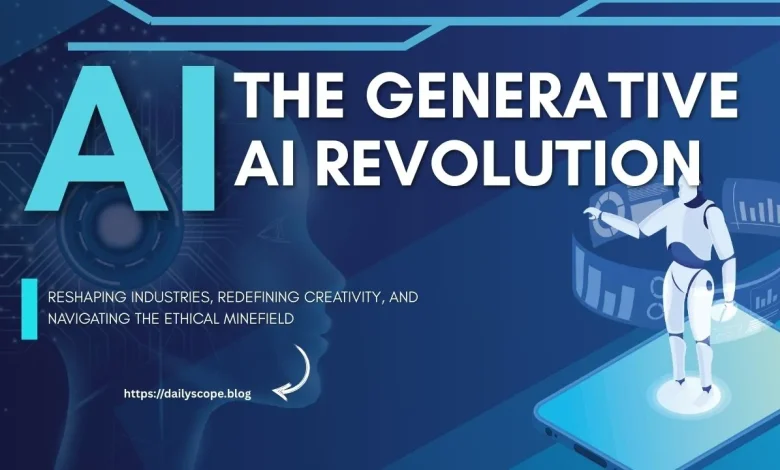
The Generative AI Revolution: Reshaping Industries, Redefining Creativity, and Navigating the Ethical Minefield

AUTHOR: HUSSAIN ALI
WEBSITE: DAILYSCOPE.BLOG
It’s impossible to scroll through tech news, browse professional forums, or even converse with forward-thinking colleagues without stumbling into the gravitational pull of Generative AI. This isn’t just another incremental step in the long march of technological progress; it feels like a quantum leap, a fundamental shift in how we interact with machines and, more profoundly, how we conceive of creation itself. From crafting eloquent essays and generating photorealistic images from simple text prompts to composing symphonies and writing complex computer code, generative artificial intelligence is demonstrating capabilities that were, until very recently, the exclusive domain of human intellect and creativity.
But what exactly is powering this revolution? How is it actively transforming major sectors of our economy? And, perhaps most critically, what are the monumental ethical, social, and economic challenges we must confront as this technology continues its relentless advance? This deep dive aims to explore the intricate tapestry of Generative AI, moving beyond the headlines to understand its mechanics, its monumental impact, and the crucial conversations we need to have about our shared future.
Part 1: Demystifying the Magic – What is Generative AI?
At its core, Generative AI is a subfield of artificial intelligence focused on creating new, original content. Unlike traditional AI models designed for analysis or classification (e.g., identifying spam emails or recognizing a cat in a photo), generative models learn the underlying patterns and structures of their training data and then use this knowledge to generate novel output that is statistically similar, but not identical, to what they’ve seen before.
The magic is powered by a class of machine learning models known as neural networks, which are loosely inspired by the human brain. The recent explosion in capability is largely attributed to two key architectures:
- Transformers: Introduced in Google’s seminal 2017 paper, “Attention Is All You Need“, the Transformer architecture is the bedrock of most modern large language models (LLMs). Its genius lies in its “self-attention mechanism,” which allows it to weigh the importance of different words in a sentence, regardless of their position. This enables it to understand context and nuance in language with unprecedented sophistication. Models like OpenAI’s GPT-4, Google’s PaLM 2 (which powers Bard), and Anthropic’s Claude are all built on Transformer-based foundations.
- Diffusion Models: This is the engine behind the stunning explosion of image generation tools. A diffusion model works by a two-step process. First, it takes a training image and gradually adds noise until it becomes complete static—a process called forward diffusion. Then, it learns to reverse this process, slowly denoising a field of random pixels to construct a coherent image that matches a given text description. This is the technology powering platforms like Midjourney, Stable Diffusion, and DALL-E 3, allowing them to turn imaginative prompts like “a Victorian-era robot painting a portrait in a sunlit garden” into breathtaking visual reality.
The fuel for these powerful engines is data—massive, internet-scale datasets of text, code, and images. And the computational firepower required is provided by advanced, scalable cloud infrastructure from providers like Amazon Web Services (AWS), Microsoft Azure, and Google Cloud Platform (GCP).
Part 2: The Impact – How Generative AI is Reshaping Major Industries
The applications of Generative AI are not futuristic speculation; they are being integrated into workflows and products today, driving efficiency, unlocking new possibilities, and disrupting established business models.
1. Content Creation & Marketing
The creative industries are experiencing the most visible shockwaves. Writers, designers, and marketers are leveraging AI to augment their capabilities.
- Writing and Ideation: Tools like Jasper.ai and Copy.ai are being used to generate marketing copy, blog post outlines, social media content, and even entire articles. GrammarlyGO integrates directly into word processors to help refine tone and clarity. This doesn’t replace the human strategist but liberates them from the “blank page problem,” allowing them to focus on high-level strategy and creative direction.
- Visual Design and Art: Midjourney and DALL-E 3 have become indispensable for rapid prototyping, concept art creation, and generating unique stock imagery. Graphic designers use them to brainstorm layouts and color palettes, while advertising agencies use them to create compelling visual narratives for pitches in a fraction of the traditional time.
- Video and Audio: The frontier is already expanding into dynamic media. Runway ML offers a suite of AI-powered video editing tools, from generating short clips from text to painlessly removing backgrounds. In music, platforms like Google’s MusicLM can create audio tracks from descriptive prompts, while Suno AI allows users to generate complete songs with vocals.
2. Software Development and Engineering
For developers, Generative AI is like gaining a super-powered pair-programmer that never sleeps. GitHub Copilot, powered by OpenAI’s Codex, suggests entire lines of code and functions in real-time as developers type. It can translate code between programming languages, write unit tests, and explain complex code snippets. This dramatically accelerates development cycles, reduces boilerplate coding, and helps catch errors early. The result is not the obsolescence of programmers, but a shift in their role towards more architectural design, complex problem-solving, and managing AI-assisted workflows.
3. Scientific Research and Healthcare
The potential of Generative AI to accelerate human progress is perhaps most profound in science and medicine.
- Drug Discovery: The process of discovering a new drug is notoriously slow and expensive, often taking over a decade. Companies like Insilico Medicine are using generative AI to design novel molecular structures for new drugs, predicting their effectiveness and potential side effects in silico (via computer simulation) before any physical lab work begins. This could shave years off the development timeline for life-saving treatments.
- Medical Imaging and Diagnosis: AI models are being trained to read MRIs, CT scans, and X-rays, identifying anomalies like tumors or fractures with a level of speed and consistency that can augment radiologists. They can also generate synthetic medical data to help train other AI models without compromising patient privacy.
- Material Science: Researchers are using AI to generate hypotheses for new materials with specific properties, such as more efficient batteries for renewable energy storage or stronger, lighter alloys for aerospace.
4. Business Operations and Customer Experience
Across the corporate world, Generative AI is streamlining operations and personalizing interactions.
- Customer Service: AI-powered chatbots and virtual assistants have evolved far beyond simple scripted trees. Leveraging LLMs, they can now understand complex customer queries, access relevant knowledge bases, and provide nuanced, helpful responses in natural language, drastically reducing wait times and freeing human agents for more sensitive issues.
- Legal and Compliance: Law firms and corporate legal departments are using tools like Harvey AI to sift through thousands of legal documents for discovery, draft and review contracts, and summarize case law. This reduces immense amounts of manual labor and allows lawyers to focus on client strategy and courtroom advocacy.
- Internal Knowledge Management: Enterprises are deploying “corporate brains”—AI systems that can answer employee questions by drawing upon the company’s entire internal wiki, document repository, and communication channels. This makes institutional knowledge instantly accessible.
Part 3: The Double-Edged Sword – Ethical and Societal Challenges
For all its promise, the rise of Generative AI is fraught with peril. The speed of its development has outstripped our societal, legal, and ethical frameworks, creating a landscape riddled with complex challenges.
1. Bias and Fairness
The old computing adage “garbage in, garbage out” is terrifyingly relevant here. Generative AI models are trained on data created by humans, and the internet is a reflection of our best and worst impulses. These models can inadvertently absorb and amplify societal biases related to race, gender, religion, and nationality. An image generator might default to stereotypes when asked for a picture of a “CEO,” or a language model might generate text with prejudiced undertones. Mitigating this requires conscious, ongoing effort in curating training datasets and developing new techniques in AI alignment to ensure these systems are fair and representative.
2. Misinformation, Disinformation, and Deepfakes
This is arguably the most immediate and dangerous threat. The ability to generate highly convincing, entirely fictional text, images, and video at scale is a powerful weapon for bad actors. We are already seeing the rise of AI-generated deepfakes used for political propaganda, non-consensual pornography, and financial fraud. As the technology improves, it will become increasingly difficult to distinguish fact from fiction, potentially eroding trust in media, institutions, and even our own eyes. This creates an urgent need for robust digital provenance standards, like the Coalition for Content Provenance and Authenticity (C2PA), and widespread public education on digital literacy.
3. Intellectual Property and Copyright
The legal ground is shifting beneath our feet. When an AI generates a song, a painting, or a piece of code, who owns it? The user who wrote the prompt? The company that built the AI? Or is it a derivative work of the millions of copyrighted items in the training data? This is the subject of numerous high-profile lawsuits against AI companies from artists, writers, and coders who allege their work was used without permission or compensation. The outcome of these cases will fundamentally shape the creative and economic landscape for decades to come.
4. Job Displacement and Economic Restructuring
The fear that automation will render human workers obsolete is not new, but Generative AI uniquely targets cognitive, white-collar jobs once thought safe. While it will undoubtedly create new roles (like AI prompt engineers and AI ethicists), it will also disrupt many others. The question is not if there will be displacement, but how we manage the transition. This necessitates a massive investment in reskilling and upskilling the workforce and potentially rethinking social contracts, with concepts like Universal Basic Income (UBI) being debated more seriously.
5. Environmental Cost
The computational power required to train and run these massive models is staggering. Training a single large language model can have a carbon footprint equivalent to the lifetime emissions of five cars. As demand for AI grows, so does its energy consumption. The industry faces a critical challenge in improving the energy efficiency of its models and data centers, and ensuring that the pursuit of artificial intelligence does not come at an unacceptable cost to our planet.
Part 4: Navigating the Future – The Path Forward with Responsibility
The Generative AI genie is out of the bottle, and there is no putting it back. The challenge before us is not to halt progress, but to steer it wisely. This requires a collaborative, multi-stakeholder approach.
- For Developers and Companies: Responsible AI. The principles of Responsible AI must be embedded into the development lifecycle from day one. This includes rigorous bias testing, transparency about a model’s capabilities and limitations (a concept known as model cards and datasheets), building robust safety filters to prevent misuse, and engaging with a diverse set of external stakeholders to identify potential risks early. Initiatives like Anthropic’s ConstitutionaL AI represent promising steps towards building systems that are inherently safer and more aligned with human values.
- For Policymakers and Regulators: Agile Governance. The slow pace of legislation is ill-suited to the rapid evolution of technology. We need agile, smart regulation that mitigates risks without stifling innovation. The European Union’s AI Act is one of the first comprehensive attempts to create a legal framework, proposing a risk-based approach to AI applications. Regulations must focus on high-risk use cases, promote transparency, and establish clear lines of accountability.
- For Individuals and Society: Cultivating AI Literacy. In an age of AI-generated content, critical thinking is our most vital defense. We must all become more savvy consumers of information, learning to question sources and verify claims. Educational institutions need to integrate AI literacy into their curricula, teaching students not just how to use AI tools, but how to understand their strengths, weaknesses, and ethical implications.
Conclusion: The Co-Creation Paradigm
The narrative of Generative AI is still being written. It is a tool of immense power, and like any powerful tool—from fire to the internet—its ultimate impact depends entirely on the hands that wield it. The dystopian vision of machines replacing humanity is a simplistic and, likely, an inaccurate one. A more probable and empowering future is one of collaboration and co-creation.
We are moving towards a paradigm where human intuition, empathy, and strategic thinking are amplified by machine-scale pattern recognition and content generation. The writer will partner with an AI to break through creative blocks. The doctor will consult an AI to validate a diagnosis. The scientist will use an AI to simulate a million possible experiments overnight.
The Generative AI revolution is not about the replacement of the human; it is about the redefinition of human potential. By approaching this technology with a clear-eyed understanding of its capabilities, a healthy respect for its dangers, and a steadfast commitment to our ethical principles, we can harness its power to solve some of our most pressing challenges, unlock new frontiers of knowledge and art, and build a future that is not only more efficient but more creative, equitable, and profoundly human. The prompt for our collective future is now in our hands. What we generate next is up to us.