
The Future of Artificial Intelligence: Opportunities, Challenges, and What Lies Ahead

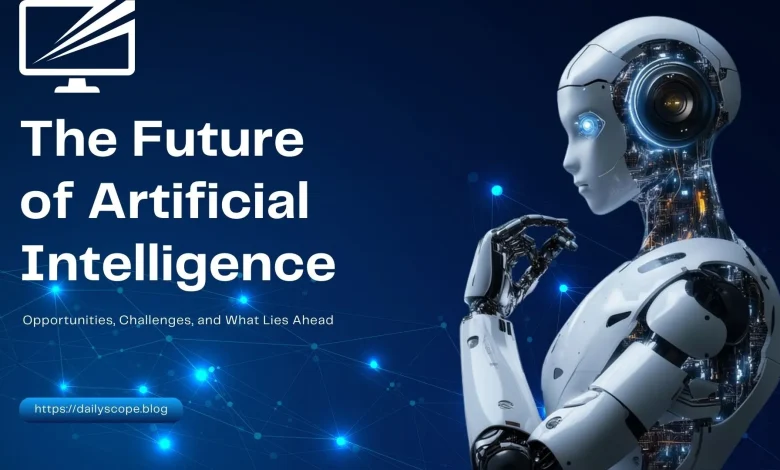
Artificial Intelligence (AI) has moved from science fiction to everyday reality. From voice assistants like Amazon Alexa and Google Assistant to advanced machine learning systems powering self-driving cars, AI is shaping industries, economies, and our daily lives. As we move further into the 21st century, AI is expected to continue evolving at an unprecedented pace.
In this article, we will dive deep into AI’s past, present, and future, exploring the opportunities it brings, the ethical challenges it raises, and what lies ahead in the coming decades.

A Brief History of AI
The roots of artificial intelligence go back to the mid-20th century when pioneers like Alan Turing and John McCarthy laid the foundation for machine intelligence. The famous Turing Test became a benchmark for evaluating whether a machine could exhibit human-like intelligence.
- 1956: John McCarthy coined the term “Artificial Intelligence” during the Dartmouth Conference.
- 1960s–70s: Early AI research focused on symbolic reasoning and expert systems.
- 1980s: Introduction of machine learning and neural networks.
- 2000s–2020s: AI breakthroughs in deep learning, natural language processing (NLP), and computer vision.
For a deeper dive, see History of AI.
Types of Artificial Intelligence
AI can be broadly categorized into three main types:
1. Narrow AI (Weak AI)
Narrow AI is designed for specific tasks. Examples include Siri, spam filters, and recommendation engines like Netflix AI.
2. General AI (Strong AI)
This is the hypothetical AI that can perform any intellectual task humans can do. Researchers are still far from achieving this.
3. Superintelligent AI
A speculative concept where AI surpasses human intelligence. Think of movies like Ex Machina or Her.
For a more detailed breakdown, visit Narrow vs General AI. top 10 richest people in world
Key Applications of AI Today
AI is not just a futuristic concept—it’s already integrated into daily life and business operations worldwide. Here are some of the most impactful applications:
Healthcare
AI is revolutionizing medical diagnosis, personalized treatments, and drug discovery. For example:
- IBM Watson Health assists doctors with diagnosis.
- AI helps detect early signs of diseases like cancer via medical imaging.
Finance
AI-driven algorithms are used in fraud detection, credit scoring, and automated trading systems.

Transportation
Self-driving cars powered by companies like Tesla Autopilot and Waymo are reshaping the future of mobility.
Retail & E-commerce
Personalized shopping recommendations on platforms like Amazon and Shopify AI are powered by machine learning.
Content Creation
AI is creating art, music, and even writing—OpenAI’s GPT models are a prime example.

Emerging AI Technologies
AI continues to advance, with new innovations appearing every year. Some of the most promising areas include:
- Generative AI: Tools like DALL·E create original images, text, and media.
- Natural Language Processing (NLP): Powering chatbots, language translation, and virtual assistants.
- Computer Vision: Used in facial recognition, medical imaging, and autonomous vehicles.
- Reinforcement Learning: Used in robotics, gaming, and optimization problems.
- Edge AI: Bringing AI closer to devices like smartphones and IoT.
For updates, see AI Trends 2025.
The Economic Impact of AI
AI is projected to add $15.7 trillion to the global economy by 2030 according to PwC. Industries such as healthcare, finance, retail, and logistics are already experiencing cost savings and efficiency gains.
Some highlights:
- Increased productivity and automation.
- New jobs in AI development, ethics, and data science.
- Displacement of repetitive, manual jobs.
Challenges and Risks of AI
While AI presents enormous opportunities, it also brings serious challenges:
Ethical Concerns
- Bias in AI: Algorithms can inherit human biases from training data.
- Privacy Issues: AI-driven surveillance raises privacy concerns.
Job Displacement
Automation may replace millions of jobs, especially in manufacturing and customer service.
Security Risks
AI can be used in cyberattacks, deepfakes, and AI-driven disinformation.
Existential Risks
Some researchers warn about the dangers of superintelligent AI exceeding human control.
For detailed discussion, check AI Risks and Ethics.
AI and Society: What Changes to Expect
AI is reshaping how societies function:
- Education: AI tutors and personalized learning platforms.
- Healthcare: Predictive analytics improving public health.
- Governance: AI used for smart cities, policymaking, and crime prevention.
- Entertainment: AI-generated movies, games, and interactive experiences.
Explore AI and Society for more.
The Future of AI: What Lies Ahead
The coming decades may see exponential growth in AI capabilities:
- Human-AI Collaboration: More seamless integration between human workers and AI.
- Brain-Computer Interfaces: Companies like Neuralink are exploring AI-human brain connections.
- Global AI Regulations: Governments will create stricter laws around AI use.
- AI for Sustainability: AI will play a crucial role in climate change mitigation and resource optimization.
For more, see Future of AI Predictions.

Conclusion
Artificial Intelligence is no longer a distant dream—it’s here, shaping how we live, work, and interact. The opportunities are vast, from healthcare breakthroughs to smarter financial systems, but so are the challenges. Balancing innovation with ethics, regulation, and human values will be key to ensuring that AI benefits humanity as a whole.
As AI continues to evolve, one thing is certain: the future will be shaped not only by technological advancements but also by the choices we make today.


I like how you broke down the different typesAI blog comment writing of AI, especially the distinction between narrow and general AI—it’s easy to overlook how far we still are from true general intelligence. One area I think will be especially interesting is how society adapts to the economic impact, not just in terms of job displacement, but also in creating entirely new roles we can’t even imagine yet. The balance between innovation and ethical responsibility will probably define the next decade of AI development.