AUTHOR: HUSSAIN ALI
WEBSITE: DAILYSCOPE.BLOG
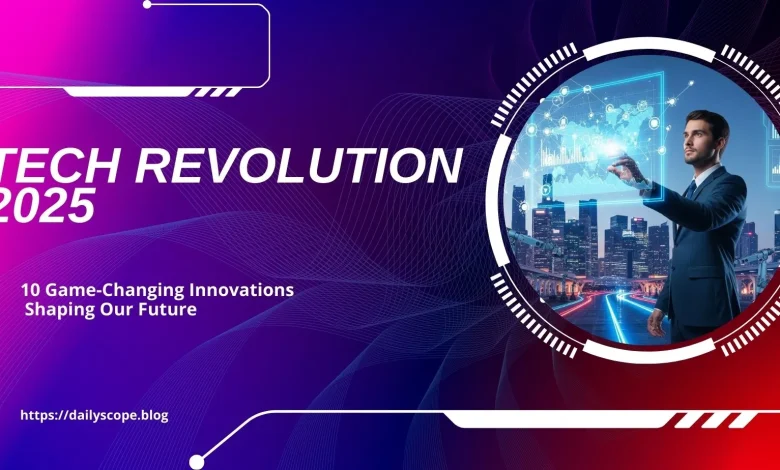
Introduction – Tech Revolution 2025
The year 2025 marks a defining moment in the history of technology. Innovations that once seemed futuristic, such as artificial intelligence, quantum computing, immersive virtual worlds, and 6G networks are no longer concepts on paper but rapidly expanding realities. According to TechCrunch, the global technology market is projected to surpass $6 trillion this year, driven by breakthroughs in AI, green energy, and hyper-connectivity.
What makes the Tech Revolution of 2025 unique is its scale and speed. In previous decades, one or two transformative technologies would emerge every few years. Today, we’re witnessing multiple revolutions simultaneously. Companies like OpenAI, IBM Quantum, and Meta are redefining how humans interact with machines, data, and each other.
Another critical factor shaping 2025 is convergence. Technologies are no longer evolving in isolation. Artificial intelligence is powering autonomous vehicles, blockchain is supporting secure digital identities, and 5G/6G networks are enabling real-time communication for billions of IoT devices worldwide. Reports from MIT Technology Review show that this cross-pollination of innovations will accelerate everything from healthcare delivery to climate change mitigation.
For businesses and individuals alike, staying informed about these shifts is no longer optional it’s essential. Understanding trends in areas like AI, cloud computing, and cybersecurity can help you make smarter investments, adopt the right tools, and protect your data in an increasingly interconnected world. Sites such as Wired and GSMA provide ongoing updates on these developments. Tech Revolution
In this series, we’ll explore the 10 game-changing innovations that are shaping our future right now. From AI-powered everything to quantum computing breakthroughs, each section dives deep into how these technologies work, why they matter, and how you can benefit from them in your business or daily life.
AI-Powered Everything – The Heart of the Tech Revolution 2025
Artificial Intelligence is no longer an emerging technology; in 2025 it’s the engine driving almost every other breakthrough. From predictive healthcare and autonomous transportation to personalized digital assistants and smart factories, AI is quietly running behind the scenes of our daily lives. According to MIT Technology Review, more than 70% of global enterprises will have embedded some form of AI into their core operations this year.
Platforms such as OpenAI, Google DeepMind and Anthropic are pushing boundaries in natural-language processing, robotics, and ethical machine learning. Their large models power everything from voice-activated medical diagnostics to real-time multilingual customer support, dramatically lowering costs and improving efficiency.Tech Revolution
In the industrial world, AI-driven predictive maintenance and supply-chain optimization are saving companies millions of dollars annually. In the consumer space, smart recommendation systems on platforms like YouTube or Spotify learn your tastes instantly, offering hyper-personalized experiences.
Crucially, AI is also becoming more accessible. Small and medium businesses can now use cloud-based AI services from AWS Machine Learning, Microsoft Azure AI or Google Cloud AI, paying only for what they use. This democratization means innovation is no longer limited to tech giants; startups and even individual creators can build intelligent apps overnight.
While AI unlocks enormous opportunities, it also raises new challenges around privacy, bias, and job disruption. Organizations adopting AI must invest in responsible AI frameworks, transparency, and ongoing employee training to ensure benefits outweigh risks.
As we move deeper into 2025, “AI-Powered Everything” isn’t just a trend it’s the foundation of the next decade’s economy, setting the stage for the other nine game-changing innovations in this series.
5G & 6G Connectivity – The Ultra-Fast Digital Highway of 2025
If artificial intelligence is the brain of the Tech Revolution, then next-generation connectivity is its circulatory system. By 2025, 5G has rolled out across most developed nations, and the first 6G pilot projects are already underway. This ultra-fast infrastructure is enabling everything from autonomous vehicles to real-time augmented reality collaboration.
According to GSMA, global 5G connections will reach 2 billion by the end of 2025, and early 6G networks promise speeds up to 100 times faster than today’s 5G with almost zero latency. Such performance allows entire factories, hospitals, and smart cities to operate as synchronized digital organisms.
For consumers, 5G and 6G mean near-instant streaming of 8K video, cloud gaming with no lag, and seamless VR/AR experiences. Businesses benefit even more: remote robotic surgery, drone-based logistics, and connected autonomous fleets become not just possible but reliable. Companies like Samsung Networks and Ericsson are leading the charge in building these networks, while device makers integrate advanced chipsets capable of handling the bandwidth.Tech Revolution
Another critical advantage of 6G is its ability to support massive IoT deployments. Billions of sensors embedded in roads, factories, farms, and homes can send and receive data simultaneously without clogging networks. Combined with edge computing offered by providers like AWS Wavelength and Azure Edge Zones it ensures that computation happens closer to the source, reducing delay and energy consumption.
But with faster speeds also come new security challenges. Experts warn that organizations must adopt Zero Trust Security models and advanced encryption to protect sensitive data traveling across these high-capacity networks. The U.S. Cybersecurity & Infrastructure Security Agency already provides guidelines for safe 5G/6G deployment.
In short, 5G & 6G connectivity form the digital highway on which all other 2025 innovations will run. Without it, AI, blockchain, the metaverse, and quantum computing could never reach their full potential. As adoption accelerates, businesses and individuals who embrace these networks early will enjoy a powerful competitive edge.
Cloud & Edge Computing – The New Backbone of Digital Infrastructure in 2025
If 5G and 6G provide the highways, then cloud and edge computing are the warehouses and power stations that make the Tech Revolution possible. By 2025, cloud services have evolved far beyond simple data storage; they will be complex ecosystems delivering AI, big data analytics, and even quantum computing “as a service” to anyone with an internet connection.
Industry leaders such as Amazon Web Services (AWS), Microsoft Azure, and Google Cloud Platform are expanding their global footprints with new hyperscale data centers capable of handling exabytes of data. These platforms enable businesses of all sizes to run advanced applications without investing in expensive hardware.
However, a major shift happening in 2025 is the rise of edge computing. Instead of sending all data to distant data centers, computation and storage happen closer to the end user at the “edge” of the network. This is critical for time-sensitive applications like autonomous vehicles, industrial robots, and remote healthcare. Services such as AWS Wavelength and Azure Edge Zones integrate seamlessly with 5G and 6G to deliver ultra-low latency and higher security.Tech Revolution
Another driver is the increasing demand for sustainable computing. Data centers are some of the largest energy consumers in the tech industry. In response, companies are investing heavily in renewable energy projects. For example, Google Sustainability has pledged to run all its cloud operations on carbon-free energy by 2030, setting a new standard for green tech.
For businesses, this shift means you can deploy global-scale applications quickly, reduce latency for customers worldwide, and only pay for the computing power you actually use. Startups, in particular, benefit from the democratization of cutting-edge infrastructure: building an AI-powered app that scales to millions of users no longer requires millions of dollars up front.
As we move deeper into the Tech Revolution of 2025, cloud and edge computing aren’t just back-end enablers; they are the foundation upon which AI, IoT, and the metaverse run. Understanding how to leverage these services will be as essential for organizations as having a website or social media presence was a decade ago.
Blockchain & Web3 – Building the Decentralized Internet of 2025
While cloud and edge computing provide the backbone for centralized infrastructure, Blockchain and Web3 are ushering in a new era of decentralization in 2025. No longer confined to cryptocurrencies, blockchain technology now powers everything from supply chain management and cross-border payments to secure digital identities and decentralized finance (DeFi).
According to MIT Technology Review, more than 300 million people worldwide will interact with some form of decentralized application (dApp) in 2025. This surge is driven by the maturation of platforms like Ethereum, Polkadot, and Solana, which enable developers to build apps that run on peer-to-peer networks rather than corporate servers.
One of the biggest shifts this year is the rise of Decentralized Identity (DID). Instead of relying on usernames and passwords stored by companies, individuals can now control their own credentials and share only what’s necessary. Projects like Worldcoin and Microsoft Entra Verified ID are experimenting with new standards for privacy and security.Tech Revolution
Beyond identity, blockchain’s transparent, tamper-resistant ledgers are revolutionizing industries like healthcare (tracking pharmaceuticals), agriculture (verifying organic supply chains), and real estate (smart contracts replacing paper deeds). Even governments are exploring blockchain for Central Bank Digital Currencies (CBDCs) and digital voting systems.
At the heart of this movement is Web3 the vision of an internet owned by its users. In a Web3 world, your data, digital assets, and online identities aren’t locked inside corporate silos but secured by open protocols. Marketplaces like OpenSea allow artists to monetize their creations as NFTs without middlemen, while decentralized finance platforms give individuals access to global lending and borrowing without banks.
However, with opportunity comes risk. Scalability, energy consumption, and regulation remain challenges. Organizations entering this space in 2025 must pay attention to evolving legal frameworks and implement smart contract audits to protect users.
As the Tech Revolution of 2025 unfolds, blockchain and Web3 represent more than just technological innovation they embody a philosophical shift toward transparency, security, and user empowerment. For businesses and individuals alike, understanding how to leverage these technologies can mean gaining a foothold in the next evolution of the internet.
AR & VR Metaverse – Immersive Digital Worlds in 2025
If AI and blockchain are the engines of the Tech Revolution, then augmented reality (AR) and virtual reality (VR) are its windows into completely new worlds. By 2025, the metaverse has evolved far beyond gaming. It is now a vast, interconnected ecosystem for work, education, shopping, entertainment, and social interaction.
Companies like Meta (Facebook) have invested billions into building platforms such as Horizon Worlds, while NVIDIA’s Omniverse enables designers and engineers to collaborate inside shared 3D environments. Hardware has also caught up: lightweight AR glasses and next-gen VR headsets deliver near-photorealistic visuals with low latency, powered by the ultra-fast 5G and emerging 6G networks you read about in Section 3.Tech Revolution
For consumers, this means shopping inside virtual malls, attending concerts with friends in real-time 3D, or walking through digital showrooms before making a purchase. For businesses, AR and VR offer training simulations, remote equipment maintenance, and immersive marketing experiences that were impossible on flat screens. According to Wired, global spending on AR/VR solutions is projected to exceed $70 billion in 2025.
Education and healthcare are also being transformed. Universities deploy VR classrooms that make students feel as if they’re physically present with professors and classmates worldwide. Surgeons are using AR overlays during complex operations, blending real-time data with the physical world. Start-ups like zSpace and Osso VR are at the forefront of these applications.
Privacy, safety, and interoperability remain big issues. As more of our lives take place in these immersive spaces, companies must establish clear policies on data collection, moderation, and cross-platform standards. Organizations like the Metaverse Standards Forum are working to create open protocols so users can move seamlessly between different virtual worlds without losing their identity or digital possessions.
In 2025, the AR & VR Metaverse is no longer a science-fiction concept but an everyday reality that blends the digital and physical. Those who understand how to build, invest, or simply participate in these immersive spaces now will be best positioned to thrive as the Tech Revolution accelerates.
Green Tech & Sustainability – Powering the Tech Revolution Responsibly in 2025
Behind the dazzling advances in AI, 6G, and the metaverse lies an urgent challenge: how to power the Tech Revolution without destroying the planet. In 2025, Green Technology is no longer a niche; it’s a mainstream priority for every major tech company. Data centers, device manufacturers, and even blockchain networks are under pressure to cut carbon emissions, conserve water, and use renewable energy.
Tech giants are leading the way. Google Sustainability has committed to running its entire global operations on carbon-free energy by 2030, a milestone that will influence the entire industry. Microsoft is aiming to become carbon negative by 2030, removing more carbon than it emits, and Apple is designing all new products with recycled materials and a fully renewable supply chain.Tech Revolution
The hardware side is also going green. Semiconductor manufacturers such as TSMC and Intel are building energy-efficient chips that reduce power consumption for AI and edge devices. Cloud providers are developing serverless architectures that dynamically scale computing resources, cutting waste and cost. Blockchain developers are moving from proof-of-work to energy-efficient consensus mechanisms like proof-of-stake, reducing the environmental impact of decentralized apps.
Green tech is also spurring innovation in entirely new sectors. Smart grids, powered by AI and IoT sensors, optimize energy distribution in real time. Electric and hydrogen-powered vehicles, built by companies like Tesla and Hyundai, are paired with renewable charging networks. Startups are experimenting with carbon capture, sustainable materials, and circular-economy business models that eliminate single-use electronics.
For businesses, investing in sustainability isn’t just a moral choice; it’s an economic advantage. Consumers and governments are demanding greener products, and investors are rewarding companies with strong ESG (Environmental, Social, and Governance) performance. According to MIT Technology Review, global spending on clean-tech solutions is projected to surpass $2 trillion by 2025.
As the Tech Revolution 2025 accelerates, Green Tech & Sustainability ensure that progress doesn’t come at the expense of our environment. Organizations that integrate renewable energy, ethical supply chains, and eco-friendly design into their strategies today will not only comply with regulations but also win customer trust and future-proof their operations.
Quantum Computing – Unlocking Unimaginable Processing Power in 2025
If artificial intelligence is the brain and 6G is the nervous system of the Tech Revolution, then quantum computing is its supercharged engine. By 2025, quantum computing has moved from university labs into the hands of businesses and governments worldwide, offering processing power that can solve problems impossible for even the fastest supercomputers.
Companies like IBM Quantum, Google Quantum AI and D-Wave now provide Quantum-as-a-Service via the cloud. This means a pharmaceutical company can run drug discovery simulations on a quantum processor, a logistics firm can optimize its supply chain in real time, and banks can test new financial models — all without owning a quantum computer. Microsoft Azure Quantum is even integrating quantum tools directly into its developer platform.Tech Revolution
Quantum computing’s advantage lies in its use of qubits, which can represent multiple states simultaneously, enabling massive parallelism. This allows quantum machines to excel at tasks like cryptography, molecular modeling, climate forecasting, and optimization problems. In 2025, researchers are already demonstrating breakthroughs in quantum error correction and quantum networking, paving the way for more reliable, scalable systems.
Governments are taking note. The U.S., China, and the EU are investing billions in quantum R&D to secure leadership in this strategic technology. According to MIT Technology Review, global quantum computing spending is expected to top $20 billion annually by 2025, with private venture capital pouring into start-ups focused on quantum algorithms, hardware, and security.
But quantum computing also brings challenges. Existing encryption methods could be rendered obsolete once large-scale quantum machines arrive, making post-quantum cryptography a top priority for cybersecurity experts. Organizations must begin preparing now by testing quantum-safe protocols and training talent in quantum programming languages like Q# and Qiskit.
For businesses, the key is to experiment early. Many cloud providers offer free or low-cost access to small quantum devices so developers can learn the basics. By doing so, they’ll be ready to seize opportunities when quantum computing matures into a mainstream service.
As the Tech Revolution 2025 accelerates, quantum computing represents one of its most transformative frontiers not just a faster computer, but a completely new way of thinking about computation itself. Those who understand and adopt quantum tools now will hold a decisive advantage in the next decade of innovation.
Cybersecurity & Privacy – Protecting Data in the Age of Hyperconnectivity
Every innovation you’ve read about so far AI, 6G, cloud, blockchain, quantum computing creates extraordinary opportunities but also a massive new attack surface. By 2025, cyberattacks are more frequent, more sophisticated, and often powered by AI themselves. Protecting sensitive data and maintaining user trust is now a top-tier priority for every business, government, and individual.
According to MIT Technology Review, global spending on cybersecurity will surpass $300 billion in 2025. High-profile breaches and ransomware incidents have made consumers demand stronger privacy controls, while regulators around the world tighten data protection laws. The EU’s GDPR has inspired similar frameworks in Asia and the Americas, making compliance a global issue.Tech Revolution
Organizations are embracing Zero Trust Security a “never trust, always verify” model promoted by the U.S. Cybersecurity & Infrastructure Security Agency. Instead of relying solely on perimeter defenses like firewalls, Zero Trust verifies every user, device, and connection continuously. Passwordless authentication, multi-factor verification, and behavioral analytics are becoming standard.
Privacy is also front and center. As more data flows through AI models, cloud services, and IoT devices, companies must adopt privacy-by-design practices. Encryption at rest and in transit, anonymization, and differential privacy are no longer optional features but expected norms. Consumer-facing tech giants such as Apple are marketing privacy as a core product feature, while browsers like Mozilla Firefox automatically block third-party trackers.
The rise of quantum computing makes preparing for the future critical. Security researchers are working on post-quantum cryptography to ensure today’s sensitive data won’t be decrypted by tomorrow’s quantum machines. Cloud providers like AWS and Microsoft Azure are already piloting quantum-safe algorithms.
For individuals, good cyber hygiene remains the first line of defense: updating software regularly, using strong unique passwords (or password managers), enabling MFA, and being vigilant about phishing. For organizations, 2025 is the year to invest in security talent, run red-team exercises, and build incident-response plans that assume breaches will happen.
As the Tech Revolution 2025 unfolds, Cybersecurity & Privacy are not just protective measures; they’re competitive differentiators. Businesses that demonstrate they can keep data secure and respect user privacy will earn trust the most valuable currency in a hyperconnected world.
Final Thoughts – Navigating the Tech Revolution 2025 and Beyond
We’ve travelled through AI, 6G, IoT, blockchain, quantum computing, green tech, AR/VR, automation, and cybersecurity. Each section showed how fast the digital landscape is evolving, but together they form a single story: the Tech Revolution 2025 is not just about gadgets and apps, it’s about a fundamental shift in how humans work, live, and interact with the world.
For businesses, 2025 is the year to embrace digital-first strategies. Those who invest in AI-driven decision making, secure cloud infrastructures, and sustainable innovation will lead their markets. For governments, it’s about balancing regulation and innovation, protecting citizens while enabling new economic growth. And for individuals, it’s time to keep skills current, stay privacy-aware, and explore new opportunities that didn’t exist even a few years ago.
This revolution is also deeply interconnected. 6G networks enable IoT; IoT generates data for AI; AI runs in the cloud secured by blockchain; quantum computing threatens and enhances cryptography; green tech ensures we do it sustainably. Understanding these connections will give you an edge whether you’re an entrepreneur, policy-maker, or everyday user.
At the heart of it all is trust and responsibility. Emerging technologies hold the power to solve some of humanity’s biggest challenges from climate change to global health but only if deployed ethically, inclusively, and with strong privacy safeguards. As DailySearch Blog regularly highlights, tech is not just about wealth creation; it’s about shaping a fairer, smarter, and more resilient future.Tech Revolution
2025 is not the finish line. It’s the launch pad. Artificial intelligence, quantum breakthroughs, and hyper-connectivity are just entering their inflection points. The decisions made today by engineers, businesses, and ordinary citizens will shape the next decade of innovation.
So whether you’re a student, an investor, or simply a curious reader, take this moment to learn, experiment, and participate. The Tech Revolution 2025 isn’t something happening to you; it’s something you can help build.